Get Rid of It!! — The Idea of Salvation

We should completely get rid of the idea of salvation. Salvation is a BAD idea. I’ve written about this before. Here’s a clip from that post:

Salvation is a bad idea because:
1. It’s based on a naïve and sentimental view about how life should be.
2. It says that humanity and the world are intrinsically flawed and need fixing.
3. It has requirements that must be met, or salvation won’t be attained. This creates the fear of losing out or even suffering negative consequences. In some situations, this can be personally damaging.
4. It can lead to unwavering dogmatism and denigration of those who have it wrong.
5. It provides the opportunity for religious institutions (and cults) to exert control over their adherents.
6. It can create a fatalism about this world that thwarts full engagement in making it a better place.
7. It creates an elite class of those who get the requirements right.
8. It casts a negative light on ultimate reality as the source of this reality and makes any fruits of that reality suspect. Theologically, God messed up.  Non-theologically, whatever is the source of this reality is either indifferent, evil, or incompetent.

So, if we get rid of the idea of salvation, then what? Then we can focus on what really matters – how we live. What’s ultimately important is how we treat ourselves, each other, other creatures, and our world. That’s it.

Does that mean that worldviews don’t matter? Absolutely not. Worldviews orient us in the grand scheme of things. They give us a sense of who and what we are, our place in the cosmos, and help us determine how we should live. In other words, they ground our sense of what it means to live a good life. Now, in that sense, if we get rid of the idea of salvation, then the conversations about worldviews can be helpful. If we can agree that how we live is what is ultimately important, then those dialogues can be constructive toward a better world.

Now, I don’t presume that getting rid of the idea of salvation will be easy. It won’t. There are deep existential concerns in play, and serious, profound problems to be addressed. But if we can just agree that this world is fundamentally a beneficent place and that whatever happens after life will also be beneficent, then perhaps that is enough. God chose to live finite lives (through kenosis) and experience life in all its dimensions, including the great joys and beauty as well as the great tragedies. All this is what makes life meaningful both for God-as-transcendent and God-as-living (God’s incarnations) as us and all other creatures. If we can accept that life has great value in all its dimensions, then we can see that this reality is not a mistake in need of a fix and instead get on with the hard work of living the best we can and shaping this world for the good of all.

After Life

One of the guiding principles I have adopted for developing a theology is minimalism. Metaphysical speculations should be kept to a minimum and only arise where they are needed to offer answers to pressing existential questions and are actionable in life. Accordingly, with respect to the topic of an afterlife, I don’t have much to say. However, most people are concerned about the question, so I think it should be addressed as best it can be within the minimalist constraints.

There are all sorts of speculations in religion and philosophy about what happens after death. They range from a dissolution of the self within the ultimate to having some sort of “existence” beyond. That existence could be non-corporeal (a spiritual being), a heavenly existence, a rebirth to another life (reincarnation), or some other formulation.

What I can say, coming from the ontology of a divine idealism is that even after our earthly life ends, the memory of us and our life is eternal in the Mind of God. What God decides to do with that memory could take many forms. This is where all I can offer are some possible options that come to mind. There could be many others.

  • Those memories could be just archived (so to speak) with nothing more happening. However, a particular life doesn’t just go into the dustbin of history. Just as our memories of past loved ones affect us now, so it would be with God.
  • There could be an essence of a life that gets re-instantiated in some form and lives again.
  • There could be an integration of many individual lives’ memories into some sort of composite for another life. After all, our bodies are a composite of many other beings like cells, organs, viruses, and bacteria all working together.
  • We might also think about the Author/Story metaphor I often refer to. In a novel, although a particular narrative eventually comes to an end, the characters in that narrative may be revived in subsequent narratives (sequels) and live again. God could create other narratives within God’s Mind where a particular life takes on a new life, perhaps in a very different type of setting and in a very different form than in this life. Since God obviously places such a great value in life and individual lives, I believe this is the most likely scenario.
  • There could be some other afterlife that we would have no concept of.

It is important to remember that all these options are just metaphors. The true reality of things could be very different.

That’s about all I would be willing to speculate about. But here’s the thing. I firmly believe that God loves each and every person and creature. If we believe that, then we can also believe that God will act in a loving way toward each life. Personally, I think that is enough.

You are an Incarnation

The term incarnation derives from the Latin verb ‘incarno’, which itself is derived from the prefix ‘in’- and ‘caro’, “flesh”, meaning “to make into flesh” or, in the passive, “to be made flesh”. This term is prominent in Christian theology but the idea of a god “becoming flesh” is nothing new. In fact, in one of the earliest ancient texts — The Epic of Gilgamesh (circa 2100 BCE), Gilgamesh is 1/3 human and 2/3 god. Besides Christianity, it also shows up with the avatars in Hinduism and in Greek mythology where a god takes on human form.

The fundamental issue that has prompted the incarnation idea is the perennial question of “the One and the Many”. This question is not surprising because as humans we have a sense of individuality but also see ourselves as participating in something greater.

Now, there are different concepts of how the One and Many are related. One model is dualism. This model arose significantly during the axial age with the emergence of the monotheistic religions of Christianity and Islam. It says there is a stark ontological otherness of the divine and the world. Zoroastrianism, which had considerable influence, is a prime example of this dualism. In this model, God is wholly other from this world.

There are well-known problems with forms of dualism. Theologically, it presents problems of interaction and intervention between God and the world. Philosophically, there is an interaction problem represented by the mind/body issue. I won’t discuss dualism in depth here because I want to suggest an alternative — monism.

Monism
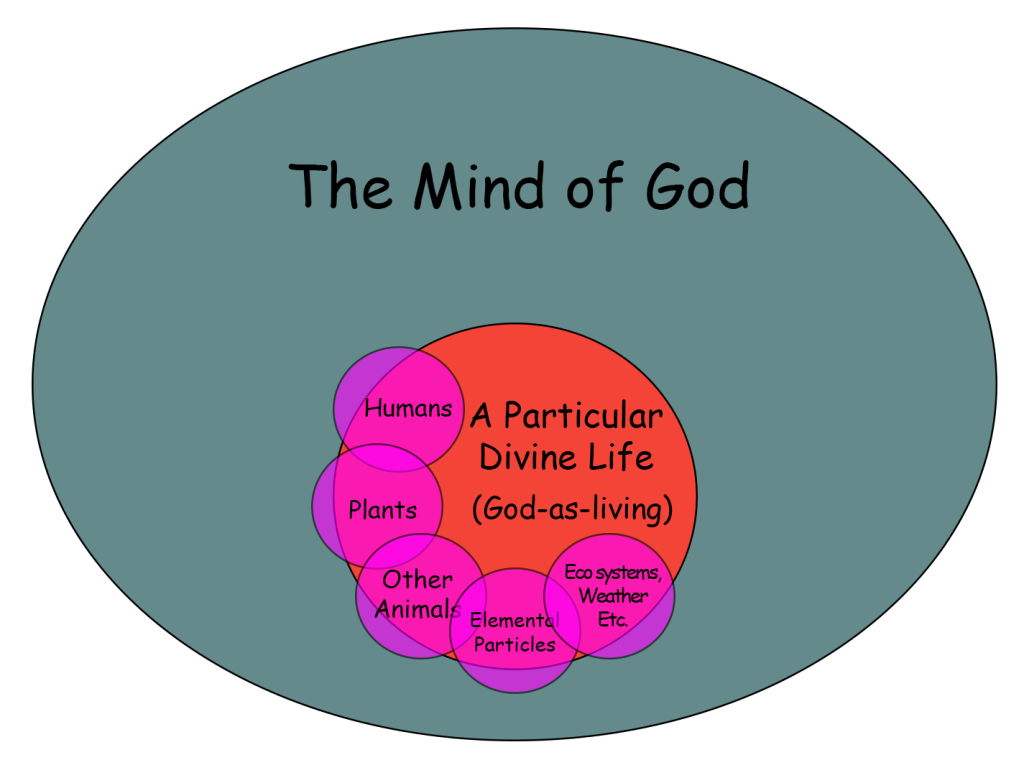
In monism, there is only the One but there are distinctions to be made within the One. Those distinctions represent the Many. So, how are the distinctions characterized? This can vary within metaphysical systems, but I describe a distinction as an ‘aspect’ of the One. An aspect is both a part of something and a unique perspective. These ‘aspects’ could also be thought of as incarnations (the ultimate becoming finite). This “becoming finite” is represented by the Greek word, ‘kenosis’, and shows up in various wisdom literatures including Christianity. Kenosis means the act of emptying or self-emptying.

There are similar characterizations of this type of monism in various metaphysical systems. As an example, in a popular form of Hinduism, Vishishtadvaita Vedanta, the term used is ‘qualified’ in qualified monism. Brahman is the One, but the Many are real manifestations of the One. In the West, it also shows up in some forms of panentheism. A common metaphor for this is “The world is the body of God”.

Here are some Venn diagram metaphors that illustrate this (a priority monism) and the Divine Life Communion extensions of that ontology (about being).

If this ontology is entertained, there are some very significant implications.

Personally, it means you are an incarnation — a finite manifestation of God in this reality. Since the theology offered here is a thoroughgoing panentheism, there is both a transcendent nature of God and a living nature. Accordingly, I call these incarnations, God-as-living.

As an incarnation, there are several intrinsic features of your being.

First, you have a transcendent divine depth within you. Although you are finite, you also participate in God-as-transcendent. This means you do have access to divine revelation. Now, as finite creatures, this revelation often presents itself in ambiguity. This is why we must constantly challenge ourselves and our beliefs and be humble about our positions.

Second, it means you inherit a finite share of transcendent divine freedom. There are obviously constraints inherent in a finite life, but within those constraints, you do have freedom of choice.

And third, you are loved and eternal within God. Metaphorically, just as a parent loves their child, God-as-transcendent loves each incarnation. This means you are never alone, no matter what the trial is you may be going through. This also has implications regarding the afterlife. I talk about this in my essay on “After Life“.

There is much more to say about all this and that is covered in the various essays on the website.

Emotional Commitments

Today I’m going to psychologize a bit concerning the formulation and evaluation of worldviews and metaphysical systems. In 1994, I read the book “Descartes’ Error” by neurologist António Damásio. It was a game-changer for me. At the time, I subscribed to a common notion that emotions could be the bane of being rational. Both Plato and Aristotle felt that reason was superior to emotions or as they called them, the passions. The idea is that emotions can taint reason. This view is understandable because who hasn’t seen either in themselves or others where emotions can lead to unreasonable conclusions? I felt the same way. However, that view changed after I read Damasio’s book.  There were similar books like Joseph Ledoux’s “The Emotional Brain”.

What Damasio and others showed was that emotions aren’t just some independent force tainting reason but actually an intrinsic and necessary part of reason. In his book, he talks about several real-life examples of what is going on. These examples illustrate what happens when the parts of the brain associated with emotions become damaged. A famous example of this Phineas Gage. Gage was a construction foreman who was installing an explosive charge into a hole in a rock. An accidental spark ignited the charge and drove a tamping iron through his left eye and into his left frontal lobe. He survived that accident, but his personality was changed forever. Contrary to his previous personality, he became volatile and profane with poor judgment and the inability to take on complex tasks.

An even more striking example Damasio recounts is a man who by all accounts was a perfectly reasonable, rational individual, well known for his judgment in complex issues. This man, however, sustained a lesion in an area of the brain known to be responsible for emotions. While not life-threatening, this damage had a lasting effect on the man. His psychological affect (emotions) became subdued. Also, whereas before his judgment was unassailable, after the disease that changed dramatically. He was able to reason just as well as before but unable to make good judgment calls. He had great difficulty in making decisions and as a result, his judgments were suspect. Something was missing. That missing component seems to be emotion.

What are we to make of these examples? What Damasio and others claim is that emotions are a critical element in making judgments. They are not necessarily a taint on making well-reasoned judgments but instead are crucial for them.

So, what’s going on with the process of reason? There is obviously a strong element of logic involved. The structure of logic creates guard rails within which the process can proceed, avoiding wild unsustainable threads of thought. However, logic is not some sterile, simple process. Logic requires language and language is inherently value-laden. Each step in reasoning has a value associated with it. In a simple case, this valuation is embedded in subscribing to things like the law of noncontradiction or the excluded middle. It can also be encoded in a list of logical fallacies. These are all value-laden because there is a sense of wrongness (a value) to them. In other words, emotions are in large part about valuations. The reason emotions manifest themselves in physiological ways (feeling good, being anxious, rapid heartbeat, sweating, feeling calm) is because there are deep-seated values at work.

This value may not be something simple but rather a combination of many factors. However, even with its complexity, in the gestalt (holism), it offers a weighting force.  It pushes the reasoning in certain directions.

Emotional Commitments
As life proceeds from childhood, various emotions are imbued within us. These proceed from both positive and negative experiences. Early on, pleasure and pain play a pivotal role in the valuations we make about circumstances and our response to them. As we get older, our valuations become more complex and nuanced. Still, these emotional (valuational) responses shape how we will evaluate what is presented to us and influence our response. There are what I’ll call “emotional commitments”. A commitment is a strong bias toward something. However, all commitments have an emotional content. That’s because there is always some value associated with it. These commitments are deeply engrained within us and almost autonomic. One might call these “knee-jerk” responses just like those tested in the doctor’s office. This can be advantageous because we can make very fast decisions. It can be valuable in certain circumstances but also problematic if those biases are counterproductive. The point is that we all have emotional commitments toward a certain perspective of reality. Those commitments shape how we will evaluate new experiences and information as it arrives. Depending on what those commitments are it can create either a blockage or openness to the new we experience and what it entails.

Metaphysical Emotional Commitments
Is there any doubt that there are strong emotional commitments in metaphysical worldviews? One has only to witness the heated arguments among opposing worldviews. Metaphysics speaks to “beyond or underlying the physics”.  Since the foundations of reality are underdetermined by our knowledge and perspective, metaphysics speculates about the unknown and what it might mean. As such, there are existential concerns (life, death, meaning, freedom, value, etc.) in the balance. These concerns reflect our sense of self and the meaning of our lives. No wonder there are emotions involved.

For millennia there have been many metaphysical formulations offered. They try to offer a picture of reality that addresses not only what empirical investigations suggest but also existential concerns (what we care about deeply). For those interested in creating or evaluating metaphysical systems, I think emotional commitments should be considered. What might those be?

Emotional commitments are as complex as individuals. They stem from the entire history of the individual as well as their engrained makeup, be it genetic or cultural. As psychology has shown, they may even be a mystery to the individual, buried within the unconscious mind. However, if an effort is made, they can become somewhat apparent if probed. If that task is undertaken, perhaps it can inform future choices.

At this point, I think it is also important to understand that there is a hierarchy and interaction of these emotional commitments. Some provide more force than others. There can be competition among them. They each have a certain weight in the evaluative process. This can create what psychologists call a cognitive dissonance. I offer a metaphysical metaphor about this here.  As the mental process proceeds, inevitably the strongest emotional commitments will have a strong influence on the result, often tipping the balance.

Also, another factor could be called the domino effect. In this effect, if one particular domino (say a proposition) falls then many subsequent dominos will fall as well. There is an entailment of ideas. This can be rapidly assessed in our minds. If this happens the emotional response can be multiplied enormously. Each domino represents some emotional commitment.

Here, I’ll offer an example within religious thought, but it can apply, as well, to other metaphysical worldviews. Religious philosophers, theologians, and adherents are a varied bunch. They each have their own histories and personality types. They also have their particular emotional commitments. What might those be? There is a continuum for these commitments.

For some, there is a strong emotional commitment to certainty. We see this with evangelical theologians and adherents. It is very important to them to have a sense of certainty regarding the worldview that ensues from the philosophy or theology. For some, this means a commitment to the inerrancy of some scripture or religious text. If that domino were to fall the subsequent falling of other dominos may be more than they could emotionally bear.

 At the other end of the continuum, there are religious thinkers and adherents who aren’t that concerned about certainty, and no matter how incoherent ideas may be, they are perfectly willing to accept them.

In between is where we find most of these religious thinkers. There is a commitment to rigor but also an acceptance of some level of uncertainty. They recognize that metaphysics is speculative and underdetermined.

Since we are all existential creatures, this same emotional dynamic applies across the board for any system that impinges on our existential interests. This includes metaphysical systems like atheism, theism, non-theism, agnosticism, materialism, and the like. The question to ask is what are the emotional commitments and their weighting power?

If the strongest emotional commitment is sustaining a particular worldview, that will guide what can follow and be entertained. If the strongest commitment is toward certainty, that will narrow what can even be considered. If, however, the dominant emotional commitment is to the truth, that can trump all other commitments. Obviously, that can be scary because it may mean abandoning or modifying a worldview. Not an easy task.

Conclusion
In the final analysis, creating or evaluating a metaphysical or theological system is a judgment call. However, in that process of creation or evaluation, there can also be a probing and evaluation of the personal emotional commitments that are at work. Are the commitments strongest toward the truth or are they aimed at sustaining a current position? This can be difficult to determine and requires courage to go there but if taken seriously it might result in a more stable and less conflicted state.

Knowing When to Quit — Deal-Breakers

Humans have had an interest in metaphysics for millennia. When did it all start? That’s hard to know but things like red ochre and personal items were even found in Neanderthal graves. That makes one wonder why. Then, of course, there is the long history of metaphysical thinking from early animism to what we have today.

Metaphysics reaches beyond what is straightforwardly apparent. That requires speculations. The human psyche needs to find some broad orientation for living. There are essential questions that beg for answers. What is the meaning of life? How should I live? What happens when I die? What is the good? And so on.

If metaphysical systems help people orient their lives, and inform how they should think about things, and live, the question is “Which one?” Lord knows there is no shortage of these systems. There are even new ones coming on the scene all the time. Not only are there religious systems but also non-religious systems. More-or-less systematic attempts date back at least three or four thousand years. If internet activity in forums and online media outlets like YouTube is an indication, there is considerable interest in metaphysical explorations.

For most people, these explorations aren’t just for fun. They are existentially (what matters to us) important. So, choosing one to orient one’s life around is also important. How does that choosing process come about? For most people, the choice was initially already made by their upbringing or the culture they found themselves in. However, for some, there comes a point when their current metaphysical system (religious or non-religious) isn’t working for them anymore. So, they may start looking for something else. The search is on. With so much metaphysical thought out there that can be a daunting task. However, I think it can be facilitated by understanding what essentials would have to be present in a system such that it is a viable option. We all have intuitions about what is important to us. Those intuitions may not be that explicit but they can be. They can be thought of as essential criteria that must be met.  

Understanding the essential criteria can help short-circuit a fruitless extended evaluation. If something in the system doesn’t meet a criterion, that can be a deal-breaker. It is no longer viable. Some systems are complex. So this may require scanning ahead to look for problem areas. Addressing existential issues is difficult and often put off for much later in a system (if at all). If they aren’t addressed at all, that should be a red flag. By looking for deal-breakers that can avoid a lot of wasted time. It can help one know when to quit on that particular approach. From there, the search can move on.

Now, some proposed metaphysical systems are just in the fledgling stage but might be promising. This makes things a bit more complicated. One way to evaluate an incomplete new system (or anyone that doesn’t explicitly address existential concerns) is to look at the early fundamentals and project where they can lead. A good place to start is ontology — how things fundamentally are. Is there a monism or dualism? Is it simple or complex? Is there fundamental intentionality or non-intentionality involved in how reality becomes constituted? And so on. Initial fundamentals constrain what can follow and determine whether or not it is even possible for certain criteria to be met. It takes some experience with various systems but using this method may greatly facilitate an evaluation.

Now, at this point, it is important to describe what this evaluative process looks like. Since systems contain a lot of propositional content, it might seem that the evaluations are just utilizing the step-by-step reasoning in the cognitive processes, but that need not be the case. In fact, intuitions come into play more often than not and can be a powerful tool. While intuitions often aren’t that explicit, they can still give a sense that something seems right or is off-putting. There can be a consonance or dissonance with something deep within. I talk about that here.

While so far I’ve talked about a personal evaluation of metaphysical systems, this applies equally to those who are trying to develop one. As an example, recently I’ve seen a lot in forums and online media about the problem of consciousness (subjective experience) with many proposals being offered. Inevitably, they either propose a metaphysical system or expand on one. For developers, knowing when to quit on a certain line of thinking and try something else can avoid wasted time and crucial (perhaps terminal) problems down the road.

So, as an example, here’s the list of criteria I have used to evaluate metaphysical systems and develop my own. Obviously, answers to these criteria need to be unpacked so I’ll put in links where I do so. Your criteria may be different but if you have a sense of them, perhaps you can quickly know when to quit on a particular approach. The key here is that all the criteria must be met or at least solvable without jeopardizing the others.

Essential Criteria

Systematic Criteria:

  • Logically sound (following the rules of logic)
  • Coherent (makes sense, nothing obscure)
  • Consistent (no self-contradictions)
  • Rigorous (details matter)
  • Complete (doesn’t leave out anything pertinent)
  • Elegant (no ill-conceived contrivances, only as complex as needed)

World Affirmation or World Rejection?

Metaphysics is about questions and answers. Why is there something? Why is the world the way it is?  What is the meaning of life? And so on. Some questions about reality may find straightforward answers. We can make observations and postulate reasonable explanations. However, some questions are underdetermined by observation. There can be different answers from the same observations. In that case, to formulate answers requires inferences and speculations. So, we get metaphysical systems, both religious and non-religious. These systems can vary widely. Why?

To answer that question requires a deep dive into where metaphysical systems come from and why they take the shapes they do. Obviously, that is a complex question but in this post, I want to focus on a particular feature of metaphysical systems — a value assessment of the world. That value assessment can also be complicated but it can be broadly characterized as world-affirmation or world-rejection.

Metaphysical systems don’t just pop into existence from nowhere. They emerge from worldviews. When a deep question is asked about reality, the answers are greatly influenced by the worldviews held by individuals and cultures of the time.  At any particular time in history, a certain sentiment may emerge about the state of the world. When times are hard, perhaps with lots of violence and wars going on, the assessment of the world will tend to be negative. When times are good, it may be more positive. This also applies to metaphysical thinkers and their psychological makeup.  Also, sometimes an event can create a psychological crisis that changes a worldview. Legend has it that Siddartha Gautama (the Buddha), who was raised in a privileged environment, when exposed to the real world with its troubles had his worldview dramatically changed. This spurred him on to develop what we now know as Buddhism. Other seminal religious thinkers have their own motivating histories.

Worldviews of most people may not be so dramatic. It can be just an inculcation from the family, group, or culture. Still, they shape how we think about the world and our place in it. When certain metaphysical questions are asked, the answers tend to flow from that worldview.

Metaphysical systems, while not totally linear, do build on foundational principles that set the tone for what can follow. A key factor in how those foundations are formulated is a world value assessment.  Shortly, I’ll talk about how certain assessments (world affirmation/rejection) have had a profound effect on religious systems worldwide.

Renowned sociologist of religion, Robert Bellay researched and wrote extensively on how religious sentiment evolved over the millennia. Here I’ll focus on what he says concerning a world value assessment within religion. Bellah talks about phases in religious evolution:

“There are 5 major phases in the world-wide evolution of religion. Acceptance of “this world” is emphasized in the first and last phases. Rejection of “this world” is highest in the middle phase, Historic Religion. Rejection of “this world” is a function primarily of religious dualism. Dualism reaches its peak during the historic phase when the “great, universal, ethical religions” emerged—Christianity, post-tribal Judaism, Buddhism, Confucianism, and Islam.” 

The phase of historic religion is particularly important because it is out of this phase the major world religions came into being and remain dominant worldwide.

Implications
When a particular world assessment is chosen, that has far-reaching consequences for the theology or religious philosophy.  Questions beg for solutions.  If the question is “why is the world so screwed up?” and the answer comes out of a world-rejection worldview then the answers will almost be inevitable. With a fundamentally flawed world, the obvious answers could be twofold — get out or get something new and better. This leads to two terms used in theology but also apply to religious philosophy — soteriology and eschatology. Soteriology is about salvation schemes.  If the world (or us) is so fundamentally flawed, it needs to be saved. So, we get salvation schemes. Those vary among the major traditions and even within them.  In mainstream Christianity, the world is flawed because of human sin. This leads to a judicial type of soteriology. The scales of justice must be balanced. They are balanced with the atoning death and resurrection of the Son of God (Jesus).  That balances the scales but what about this flawed world. Enter eschatology. Eschatology is about the end times when this eon comes to an end and a new one begins. Presumably, this new eon won’t be flawed like this one. What this new eon is like varies. There could be a new heaven and earth or just some heavenly (unflawed) existence.

Obviously, this mainstream approach has major theological problems. Did God screw up in creating this world? Isn’t the artisan responsible for the artifact? This presents a picture of God as an incompetent creator where a fix has to be applied. So, does God do a better job creating the new heaven and Earth? There are many other problems with this world-rejecting sentiment but that’s not what this post is about.

In the East, this world-rejection also shows up in Buddhism, Hinduism, Jainism, Daoism, and Confucianism. What we get also has various salvation schemes and eschatologies. These vary greatly among these religious philosophies but a common thread in Buddhism and Hinduism is “the liberation from or ending of samsara, the repeating cycle of birth, life, and death.” The eschatology may be more of a personal escape or transformation.

The Issue
Theologies and religious philosophies are built on fundamental tenets. They are fundamental for a reason. Fundaments are needed as a basis upon which further explications can ensue. They shape and restrict the system according to the questions asked and answers given. Since they are fundamental, any attempt to change the sentiment is highly problematic. But what if a fundamental worldview is no longer compelling? Again Robert Bellah. The first phase he calls “Primitive Religions” and the last phase (our current one), “Modern Religion”.

“Acceptance of “this world” is emphasized in the first and last phases.”

Studies show that the fastest-growing group regarding religion is the “nones” — no religious affiliation. There are many reasons for this decline but according to studies one of the major ones is that the tenets of a religion are no longer compelling or believable. In other words, they don’t seem to fit in with the current worldview.

Now, broadly speaking, I don’t view this disaffiliation as problematic. I myself became unaffiliated some 25 years ago. However, disaffiliation can have its personal downside. It can lead to a sense of loss and being spiritually adrift.  That was my case for a while. Still, disaffiliation can be a motivating force for reassessment. It can lead to spiritual or religious growth.

Now, theologians have recognized this issue for a long time. They, themselves may have experienced a sea-change in their own thinking. So, they responded. I don’t know much about other religious traditions but within liberal Christianity, there have been many attempts to reframe Christian theology to address the changing worldviews. Whether or not some may be effective is an open question. If those changes enhance people’s lives and aren’t harmful, in my view, all the better.

I believe this questioning of ancient sentiment is a positive. Life is about growth and change. A world-rejecting worldview can have significant downsides. It can lead to a complacency toward the serious problems the world faces.  If soteriology and eschatology are in the offing, why bother with concerns about the future? If escape or a new creation are the goals, that is a cop-out instead of a sober affirmation of life as it is.

If there is an affirmation of the world just as it is, that changes things dramatically. There is a call to action. I believe one of the goals for this Divine Life is the eternal creation of love, courage, beauty, and meaning. There is no perfection to be attained, only the constant effort to create the good and beautiful. Doesn’t that offer a profound meaningfulness for life? Isn’t that enough?