
The term incarnation derives from the Latin verb ‘incarno’, which itself is derived from the prefix ‘in’- and ‘caro’, “flesh”, meaning “to make into flesh” or, in the passive, “to be made flesh”. This term is prominent in Christian theology but the idea of a god “becoming flesh” is nothing new. In fact, in one of the earliest ancient texts — The Epic of Gilgamesh (circa 2100 BCE), Gilgamesh is 1/3 human and 2/3 god. Besides Christianity, it also shows up with the avatars in Hinduism and in Greek mythology where a god takes on human form.
The fundamental issue that has prompted the incarnation idea is the perennial question of “the One and the Many”. This question is not surprising because as humans we have a sense of individuality but also see ourselves as participating in something greater.
Now, there are different concepts of how the One and Many are related. One model is dualism. This model arose significantly during the axial age with the emergence of the monotheistic religions of Christianity and Islam. It says there is a stark ontological otherness of the divine and the world. Zoroastrianism, which had considerable influence, is a prime example of this dualism. In this model, God is wholly other from this world.
There are well-known problems with forms of dualism. Theologically, it presents problems of interaction and intervention between God and the world. Philosophically, there is an interaction problem represented by the mind/body issue. I won’t discuss dualism in depth here because I want to suggest an alternative — monism.
Monism
In monism, there is only the One but there are distinctions to be made within the One. Those distinctions represent the Many. So, how are the distinctions characterized? This can vary within metaphysical systems, but I describe a distinction as an ‘aspect’ of the One. An aspect is both a part of something and a unique perspective. These ‘aspects’ could also be thought of as incarnations (the ultimate becoming finite). This “becoming finite” is represented by the Greek word, ‘kenosis’, and shows up in various wisdom literatures including Christianity. Kenosis means the act of emptying or self-emptying.
There are similar characterizations of this type of monism in various metaphysical systems. As an example, in a popular form of Hinduism, Vishishtadvaita Vedanta, the term used is ‘qualified’ in qualified monism. Brahman is the One, but the Many are real manifestations of the One. In the West, it also shows up in some forms of panentheism. A common metaphor for this is “The world is the body of God”.
Here are some Venn diagram metaphors that illustrate this (a priority monism) and the Divine Life Communion extensions of that ontology (about being).


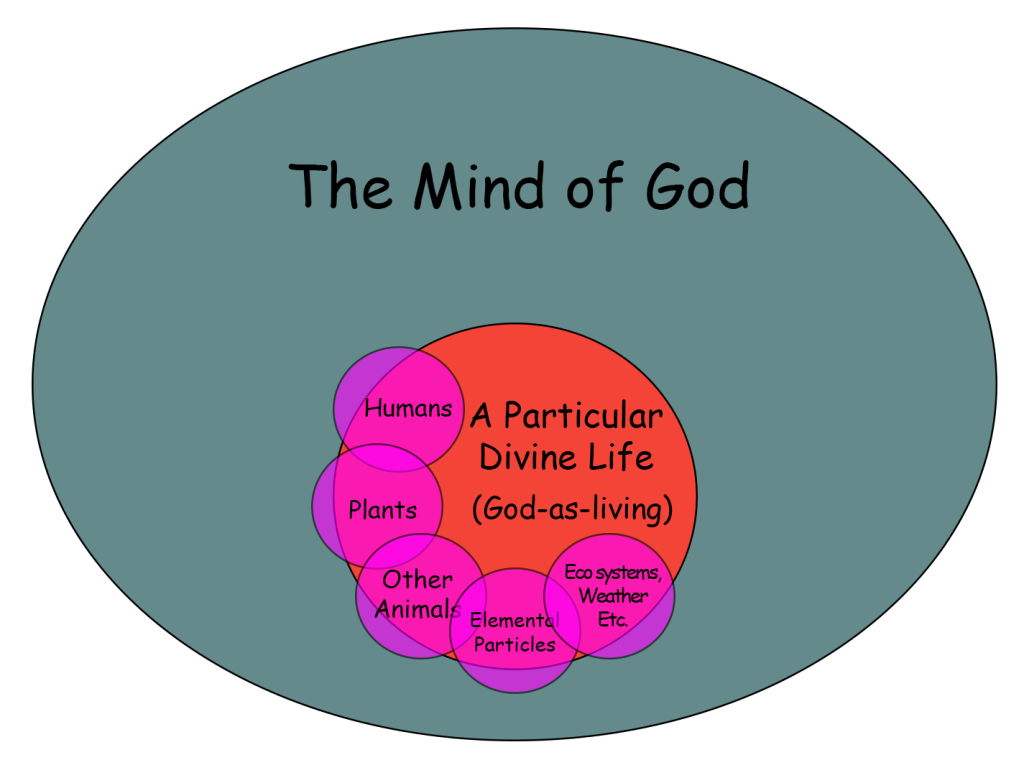
If this ontology is entertained, there are some very significant implications.
Personally, it means you are an incarnation — a finite manifestation of God in this reality. Since the theology offered here is a thoroughgoing panentheism, there is both a transcendent nature of God and a living nature. Accordingly, I call these incarnations, God-as-living.
As an incarnation, there are several intrinsic features of your being.
First, you have a transcendent divine depth within you. Although you are finite, you also participate in God-as-transcendent. This means you do have access to divine revelation. Now, as finite creatures, this revelation often presents itself in ambiguity. This is why we must constantly challenge ourselves and our beliefs and be humble about our positions.
Second, it means you inherit a finite share of transcendent divine freedom. There are obviously constraints inherent in a finite life, but within those constraints, you do have freedom of choice.
And third, you are loved and eternal within God. Metaphorically, just as a parent loves their child, God-as-transcendent loves each incarnation. This means you are never alone, no matter what the trial is you may be going through. This also has implications regarding the afterlife. I talk about this in my essay on “After Life“.
There is much more to say about all this and that is covered in the various essays on the website.
 The Divine Life Communion